The Grid Scale-Up Kit
Fit a reference photo to your sheet, rule the grid at a cell your ruler can mark, check it square, read any paper label on every basis, and choose pencils from your own swatch
GraphiteGuild's free calculators each answer one question about scaling a drawing up. The Grid Transfer Calculator scales a reference to a target width you already chose and hands back a cell such as 25.7 mm, a number no ruler carries; it never meets the sheet, its height or its margins. The Paper Weight Calculator converts one label on one basis, and the grade tools map pencils to a teaching scale that differs between makers. Writing this kit, we also found the grid calculator rounding its scale factor before using it (on this kit's example, 322.56 mm tall instead of 333.33) and the paper converter with no basis for watercolor paper, and fixed both. The Grid Scale-Up Kit puts them in order. The sheet and its margin decide the drawing area, the reference decides which side limits it, your ruler decides the cell, and a 3-4-5 block proves the grid square. On the worked example, a 3024 x 4032 pixel phone photo on A3 with a 20 mm margin, 25 mm cells give 10 columns and a drawing of 250 x 333.33 mm in 14 rows, the last one 8.33 mm tall; filling the sheet's full height instead would stretch it 10.89%. A pad labeled only 80 lb could be anything from 118 to 301 gsm depending on its basis. Every figure is computed by the site's own calculators, and the worked numbers are examples tagged as such. The kit says plainly that graphite grades differ between makers and has you swatch your own pencils rather than trust a chart, and it adds the fixative ventilation and children's AP-seal notes the free tools lack. You get a 23-page printable PDF with a scale-up worksheet, a swatch card, a paper label log and a paper weight card, plus a personalised sheet worked out from the figures you entered in the calculator.
Look inside
Two full pages from the kit, exactly as printed. Click either to read it at full size before you decide.
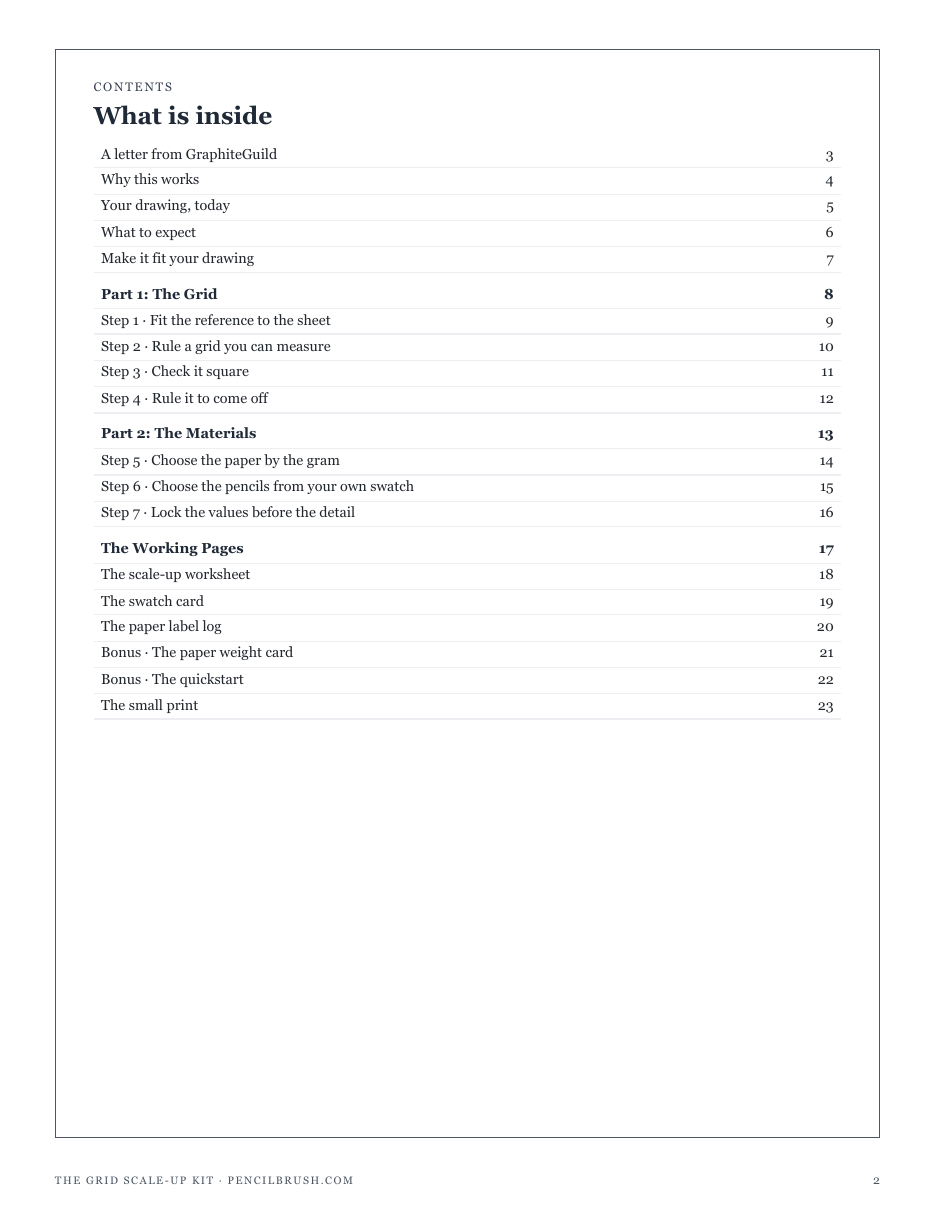
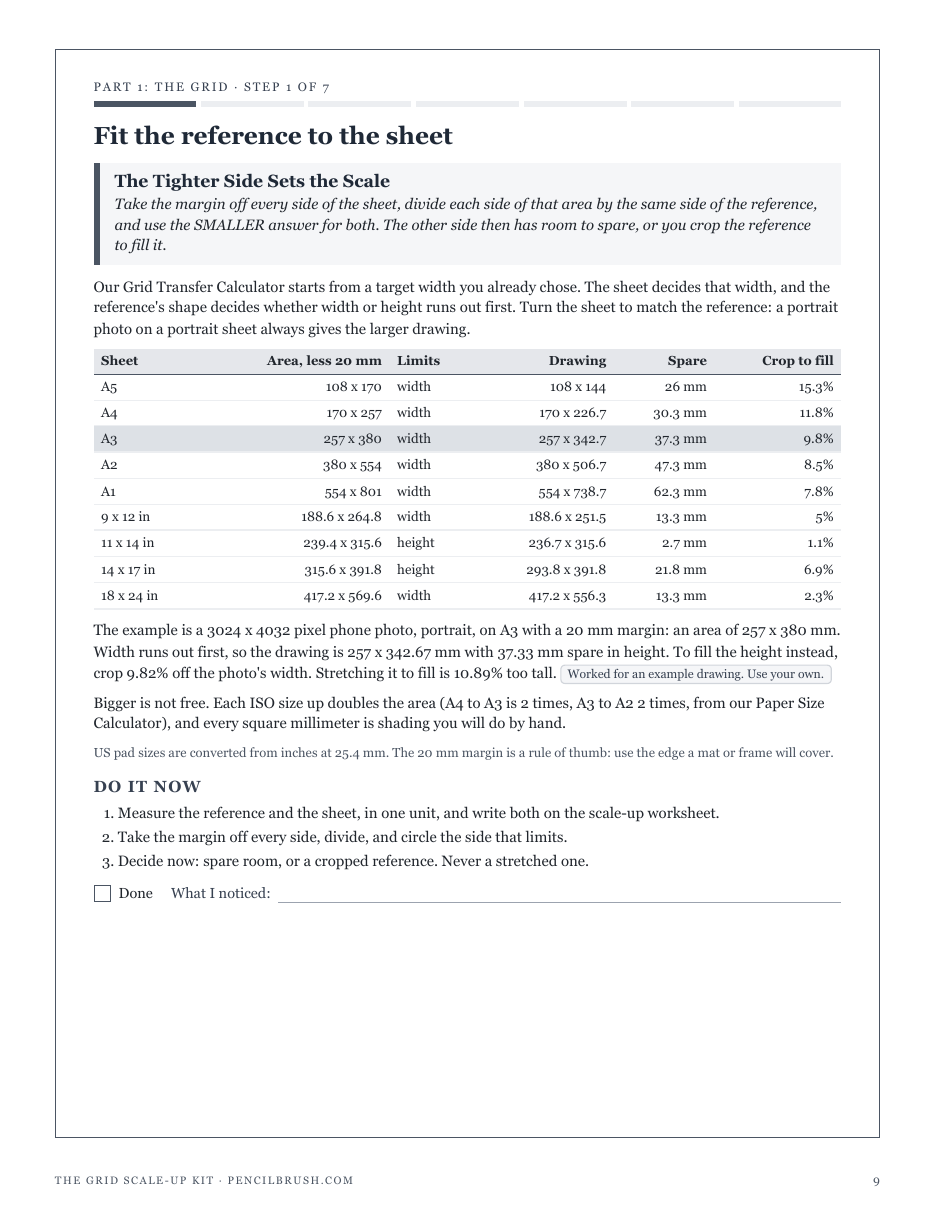
What is in it
- The Tighter Side Sets the Scale: a reference fitted to every ISO and US pad size, with the side that limits, the spare and the crop that fills
- Draw the Grid You Can Measure: ruler cells from 10 to 50 mm, with the columns, rows, last row and lines each one gives
- Three, Four, Five: the ruler check that proves a grid square, and what a stretch reads on the diagonal
- Rule It Hard, Lift It Early: the grades that erase cleanly for ruling, and when to lift the grid
- Shop by the Gram: one pound label read on all five bases, and each medium's gsm band as the labels to look for
- Your 2B Is Not Their 2B: twenty grades on nine value steps, and a swatch that decides what to buy
- Three Values, Then Detail: a 9-step value strip on your own paper, with light, middle and dark blocked first
- The scale-up worksheet, printable
- The swatch card and the paper label log, printable
- A paper weight card with every common label on every basis, and a one-page quickstart
- ✓ 23 printable pages
- ✓ 10 sections, worksheets and templates
- ✓ A second PDF worked out from the numbers you enter
- ✓ No account needed, just an email address
- ✓ Instant download; link valid 7 days
Price includes any taxes. Sold by GrabURL, who handle checkout and support. The charge appears on your statement as GrabURL.
The kit picks up where the free Grid Transfer Calculator leaves off. The calculator scales a reference to a target width you already chose; the kit fits the reference to your sheet and its margin, rules the grid at a cell your ruler can mark, checks it square with a 3-4-5 block, and rules it in a grade that lifts. It reads a pound label on every basis with the Paper Weight Calculator, chooses pencils from your own swatch rather than the grade printed on them (the Graphite Grade Reference is a teaching scale, and grades differ between makers), and locks three values with the Value Scale Generator before any detail. Use spray fixative outdoors or with strong ventilation, by the label, and give children materials with the AP seal. The worked figures are examples.